

Is Co-Payment less expensive (or better) than Co-Insurance?
The out of pocket cost differences between Coinsurance and Copayment will depend on the medications that you are using and how they are organized in a specific Medicare Part D plan.And more importantly: Coinsurance depends on the retail cost of prescription drugs and, in recent times, retail drug prices can escalate throughout the Medicare plan year.
Before we look at a few examples, let us review the two "cost-sharing" options:
- Coinsurance means that you will be responsible for a certain percent of the prescription costs (usually 25% to 30%) and the insurance
company will responsible for a certain percent of the prescription cost (usually 70% to 75%).
So for a covered medication costing $100 a month retail - you would pay $25 a month with 25% coinsurance.
- Copayment refers to a fixed dollar amount assigned to a logical grouping or formulary tier of medications (for example: $30). Usually, a formulary tier may include a specific class of medication such as, "generics" or "preferred brand name" medications. Remember that Medicare prescription drug plans are offered by companies that group their covered medications into these logical classes or tiers within the Medicare Part D formulary or drug guide. This logical grouping of medication may vary from company to company. Therefore, a medication that is grouped as a low-costing Tier 2 medication on one Medicare Part D plan, may be grouped as a more-expensive Tier 3 medication in another Medicare drug plan. So, the costs of the different copays also varies from plan to plan (for example Tier 2 may be $30 or $60) or the copays for a Generic medication Tier may vary from $0 to perhaps $7+, depending on the Medicare plan.
Here are a few examples of how the two "cost-sharing" options could compare:
- Example 1. Advair Diskus: may have a retail cost of $270
- Co-Insurance (20%) - you pay $54
- Co-Insurance (48%) - you pay $130
- Co-Payment (Preferred Brand-Name Tier) - you pay $23 to $47 (depending on the plan)
- Example 2. Cellcept: may have a retail cost of $1,300
- Co-Insurance (25%) - you pay $325
- Co-Insurance (Preferred Brand-Name Tier) (16%) - you pay $208 (depending on the plan)
- Example 3. Premarin: may have a retail cost of $130
- Co-Insurance (35%) - you pay $46
- Co-Payment (Preferred Brand-Name Tier) - you pay $42 to $95 (depending on the plan)
- Example 4. Januvia: may have a retail cost of $370
- Co-Insurance (20%) - you pay $74
- Co-Payment (Generic Tier) - you pay $22 to $47 (depending on the plan)
Where can I find an approximation of retail prescription drug cost?
Both our Formulary
Browser (showing all drugs for a single Medicare plan) and our
Drug
Finder (Q1Rx.com - showing all Medicare plans covering a single drug) display the average retail cost for medications,
details of the drug utilization management restrictions, and with the drug
cost-sharing information for all Medicare Part D plans and Medicare Advantage plans that include drug coverage.
plans.
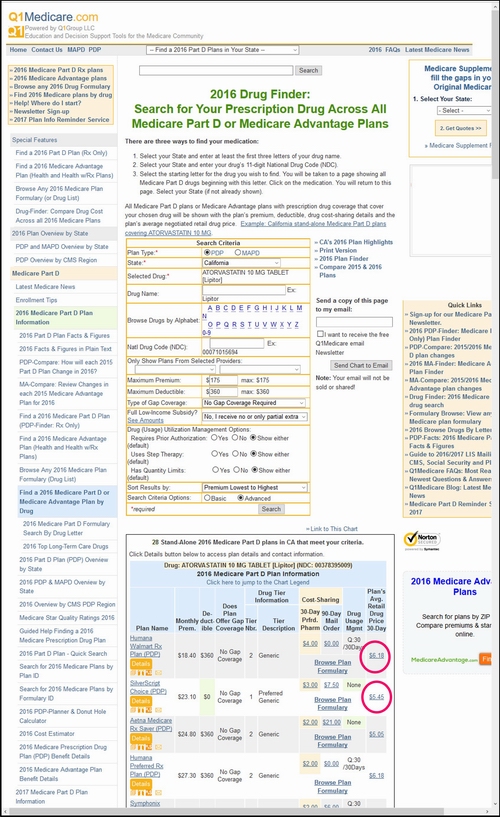
As can be seen by these cost-sharing examples above, although the retail price may vary, the copayment for this class or tier of medication remains the same and the coinsurance figure fluctuates as a percentage of the retail price - meaning your drug costs will fluctuate throughput the plan year as the retail drug price changes.
Therefore, the most affordable alternative between copayment and coinsurance plans will depend on the retail costs of medication that you are using and the placement of those medications within the tiers of a plan's formulary.
Please note that we show the historical retail price trends in our Drug Finder (Q1Rx.com) - just click on the retail price link. This means, you can see how the price for this medication has changed over the years and this may give you an idea of whether (historically) coinsurance is a riskier alternative as compared to a Medicare Part D plan that offers a fixed copayment as a cost-sharing alternative.
Find Prescription Discounts
Prescription Discounts are
easy as 1-2-3
easy as 1-2-3
- Locate lowest price drug and pharmacy
- Show card at pharmacy
- Get instant savings!
Your drug discount card is available to you at no cost.
Q1 Quick Links
- Sign-up for our Medicare Part D Newsletter.
- PDP-Facts: 2024 Medicare Part D plan Facts & Figures
- 2024 PDP-Finder: Medicare Part D (Drug Only) Plan Finder
- PDP-Compare: 2023/2024 Medicare Part D plan changes
- 2024 MA-Finder: Medicare Advantage Plan Finder
- MA plan changes 2023 to 2024
- Drug Finder: 2024 Medicare Part D drug search
- Formulary Browser: View any 2024 Medicare plan's drug list
- 2024 Browse Drugs By Letter
- Guide to 2023/2024 Mailings from CMS, Social Security and Plans
- Out-of-Pocket Cost Calculator
- Q1Medicare FAQs: Most Read and Newest Questions & Answers
- Q1Medicare News: Latest Articles
- 2025 Medicare Part D Reminder Service